To limit or delay the spreading of fires via the wooden facade, the Royal Decree imposes various requirements with regard to the reaction to fire of wooden facade cladding in its end-use conditions (in other words, as present on site). This means that when assessing the reaction to fire of the wooden facade cladding, one must take into account the potential influence of the underlying material layers and the way in which they are fastened.
These rules do not apply to single-family homes, industrial buildings, etc.
Overview of the reaction to fire requirements for facade cladding indicated in the revision in their end-use condition
Building type
Tall buildings
Medium-sized buildings
Low buildings Non-self-sufficient (type 1)
Low buildings Non-self-sufficient (type 2 and 3)
Cladding *
A2-s3,d0
B-s3,d1
C-s3,d1
D-s3,d1
* The doors, facade decorations, joints and technical equipment in the facade (e.g. signboards, lighting devices, air-conditioning grids, drain pipes, plant holders and wall penetrations for heating installations) are not subject to the aforementioned requirements, provided that their total visible surface makes up less than 5% of the visible surface of the facade concerned.
High buildings > 25 m
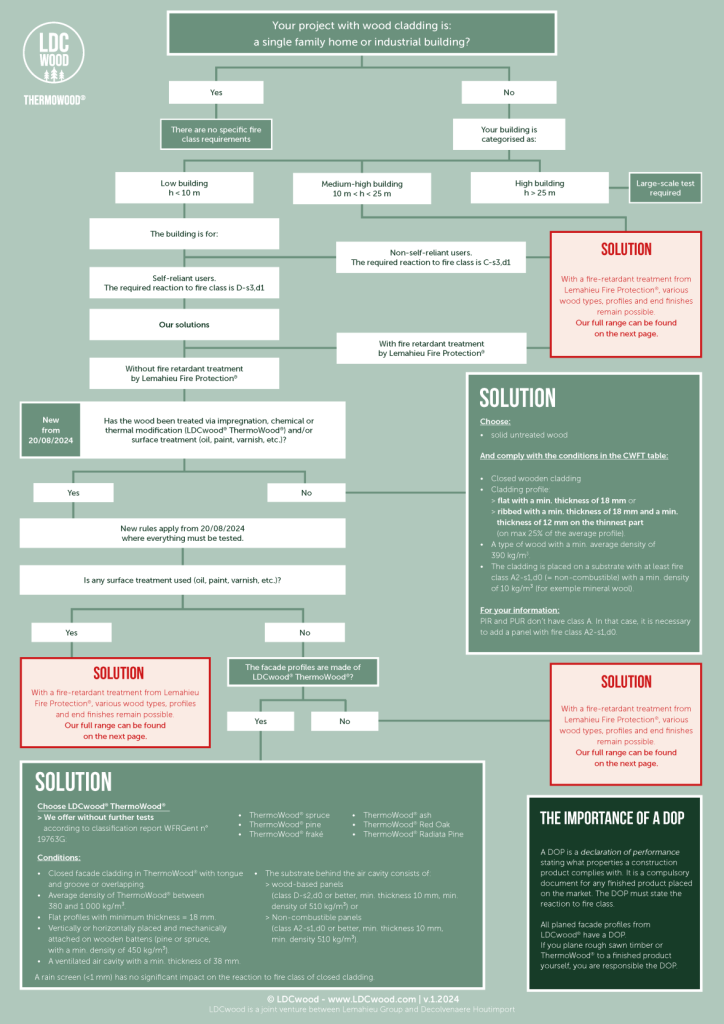
The new regulations specifically contain stricter requirements for high buildings (h > 25 m). Thus the wooden façade cladding must meet the requirements of reaction to fire class A2-s3,d0 according to the NBN EN 13501-1 (6) standard or by means of a LARGE-SCALE TEST (for example SP FIRE 105).
Medium-high buildings 10 m - 25 m
For medium-high buildings (10 m ≤ h ≤ 25 m) the requirements remain unchanged. In this case the wooden facade cladding must at least meet the requirements of reaction to fire class B-s3,d1.
Low buildings < 10 m
For low buildings (h < 10 m), the requirements depend on the type of use:
non-self-reliant users (type 1; e.g. hospitals, prisons and nurseries): the requirements for the reaction to fire class of the wooden facade cladding become stricter by moving to C-s3,d1.
sleeping self-reliant users (type 2; e.g. hotels and apartment buildings) and awake users (type 3; e.g. office buildings, shops): the wooden facade cladding must be in reaction to fire class D-s3,d1.
It is important to note that these requirements apply to timber facade claddings in their end-use conditions and not to the cladding as such.